

AI & Machine Learning Development
AI features that do a specific job inside your product.
The AI features worth building are the boring ones: answering support questions from your own docs, pulling fields out of invoices, drafting replies a person then checks, or finding the right record in a large archive. We look for the tasks in your product where AI saves real time and build those.
We work with OpenAI, Anthropic and open-source models, using Python, LangChain and vector databases. Every feature gets an evaluation set so we can measure accuracy, plus cost limits and logging, so you know what it does and what it costs before it goes to every user.
What’s included
Pick the parts you need. Most projects use all of them.
- 01
AI assistants & chatbots
Assistants that answer from your knowledge base and hand off to a person when unsure.
- 02
RAG & semantic search
Search over documents, tickets and files that understands meaning, with sources shown.
- 03
Document automation
Extracting data from invoices, contracts and forms into structured records.
- 04
AI agents & workflows
Multi-step automations that call your APIs, with approval steps where it matters.
- 05
Predictive models
Forecasting, scoring and recommendations trained on your own data.
- 06
Evaluation & monitoring
Test sets, accuracy tracking, cost dashboards and guardrails for production AI.
What you walk away with
- Use-case review and a feasibility prototype
- Production AI feature built into your product
- Evaluation dataset and accuracy report
- Cost controls, logging and usage dashboards
- Documentation and a plan for improving the model over time
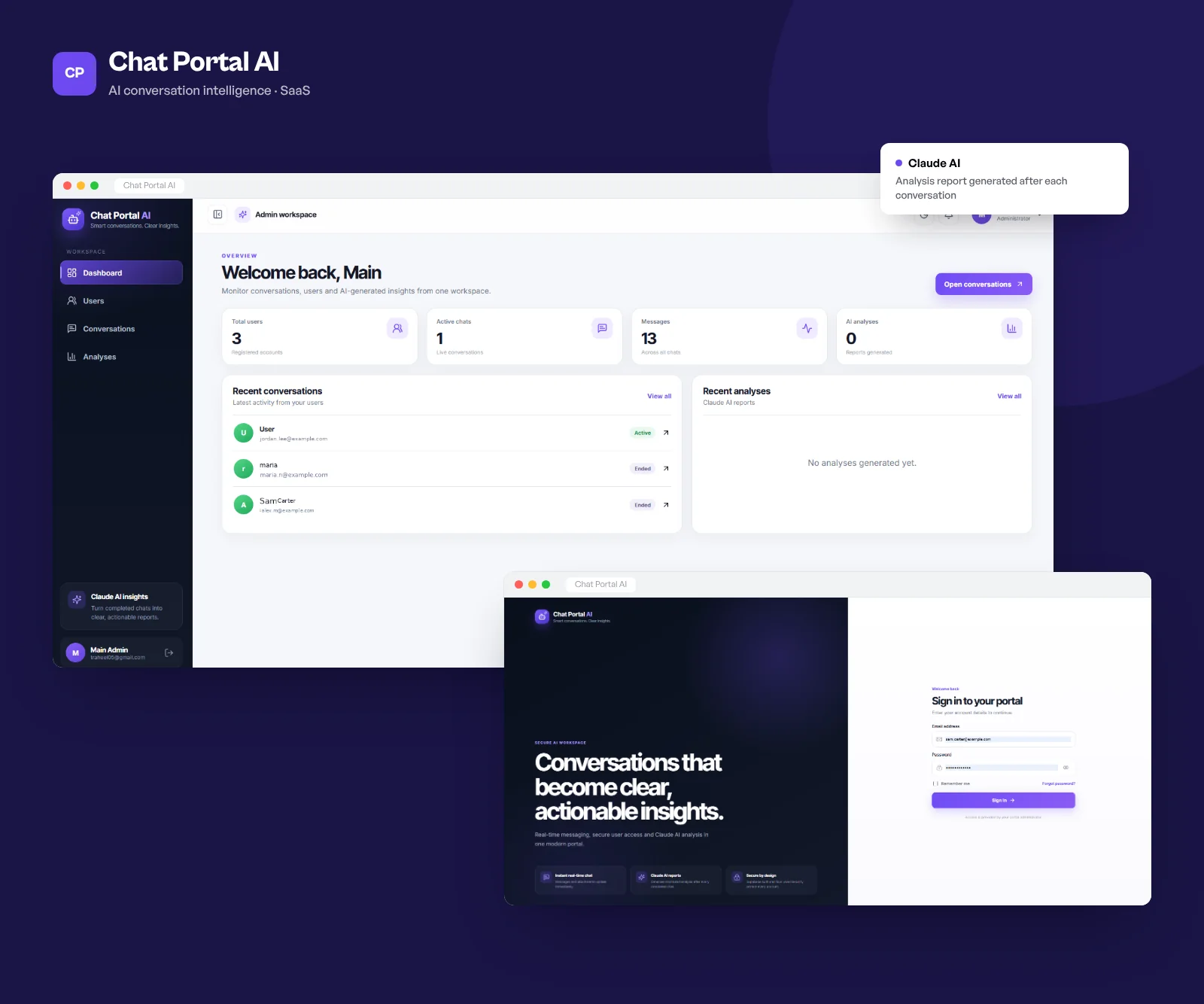
Chat Portal AI, Conversation intelligence SaaS
Tools we use
We choose per project. These come up most often for ai development work.
12345678910111213141516How a project runs
Five stages, two-week sprints and a demo at the end of every one.
Recent projects
AI Development: common questions
How much does it cost to add AI to our product?
A focused AI feature, such as a support assistant over your docs, usually costs $15k-$50k to build. Larger agent-based workflows or custom models cost more. Running costs depend on usage, and we estimate them up front.
Is our data safe with AI models?
We use providers and settings that don't train on your data, keep sensitive information out of prompts where possible, and can run open-source models in your own cloud when required.
How do you stop the AI from making things up?
We ground answers in your own content with retrieval, show sources, test against an evaluation set, and set the assistant to say it doesn't know rather than guess.
Which models do you use?
We pick per task. GPT and Claude models for reasoning and writing, smaller or open-source models for high-volume or private workloads. We often route between several to balance quality and cost.
Can AI work with our existing systems?
Yes. Most of our AI work involves connecting models to existing databases, CRMs, help desks and internal APIs.